Deep learning to identify COVID-19 lesions in lung CT scans
An efficient methodology for experimentation, transfer learning, and continuing optimization of AI models.

The COVID-19 pandemic is waging an unparalleled assault on human health.
Mass hospitalizations and the high levels of critical care required by many patients can push healthcare institutions and staff to their limits. By April 2020, the consensus was that—although not generally recommended for initial COVID-19 diagnosis—chest imaging is indicated in patients with worsening respiratory symptoms.
COVID pneumonia (viral infection in the lungs), which is detected by chest x-rays or CT scans, can predict the need for more advanced inpatient care. However, large numbers of CT scans might have to be carefully analyzed and compared with earlier scans of the same patient.
A busy hospital might perform many lung CTs per day, potentially affecting the service levels that radiology teams are able to deliver. Artificial intelligence (AI) can serve as a valuable diagnostic aid, augmenting the capabilities of radiology teams and enabling them to make optimum use of available resources.
By prescreening the CT scans of COVID-19 patients, an accurate AI model can quickly reveal critical results. Care teams can then zero in on patients at higher risk for severe complications.
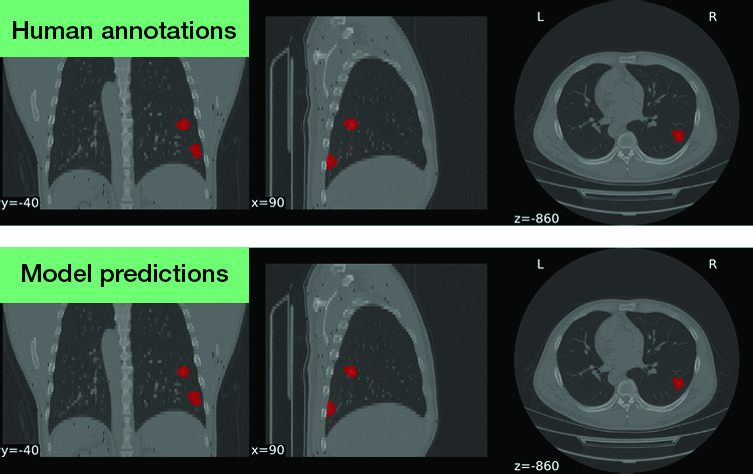
Modern deep learning models—based on convolutional neural networks (CNNs) and trained on up-to-date patient data—can identify COVID lung lesions with a high level of performance and accuracy at scale. However, model tuning, testing, and ongoing training are necessary to create and sustain an optimized AI model.
Careful attention to traceability, reproducibility, and patient privacy are essential. NetApp and SFL Scientific have developed technology for high-performing COVID-19 lung segmentation that uses a state-of-the-art model and transfer learning.
Our methodology delivers an accurate, trained model in a short time and supports ongoing training and optimization with complete traceability. Running on fast and efficient NetApp® storage infrastructure, the model takes an average of just 6 seconds to identify the COVID lesions on each patient scan (hundreds of images). This speed is on par with other advanced models and much faster than a typical human analysis of a chest CT.
Features and Benefits
The capabilities that set Deep learning to identify COVID-19 lesions in lung CT scans apart.
Rapid prototyping of an AI model for COVID-19 lung CT scans
Transfer learning approach
NVIDIA Clara COVID-19 lung CT lesion segmentation model
State-of-the-art accuracy
Fine-tuning with transfer learning
Fine-tuning with additional COVID data
Iterative model tuning experiments
Intelligent data management
NetApp AI Control Plane and Data Science Toolkit
Optimized infrastructure for AI
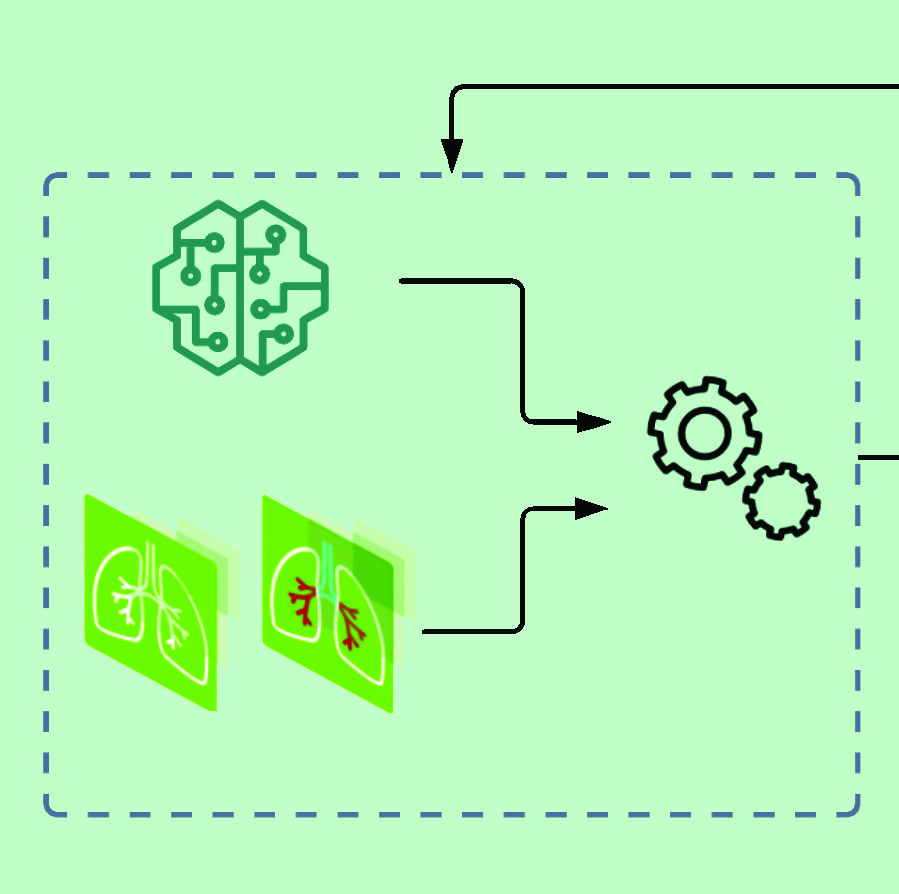
NetApp ONTAP AI
Possible clinical applications
Deployment options
- Automatic CT scan monitoring. All chest CT scans that pass through a hospital system can be automatically and routinely screened as part of the radiology workflow. This monitoring has the potential to identify asymptomatic patients.
- Clinical study treatment monitoring. By automating the comparison of scans through time, the model can help researchers evaluate the efficacy of a drug or treatment.
- Outcome prediction. Additional models can help predict disease progression for patients and optimize treatment. Outcome prediction can help hospitals manage capacity and tailor treatment plans to patient needs.
More AI opportunities
Generalized image segmentation
Beyond medical imaging
About our partnership
NetApp and SFL Scientific
Thrive with expert-led storage guidance
Get tailored advice on how Deep learning to identify COVID-19 lesions in lung CT scans fits your environment — from sizing and deployment to long-term optimization.

Technical Specifications
Exhaustive hardware and software metrics extracted directly from official documentation.
-
Average inference time per patient scan6 seconds (hundreds of images)
-
Pretrained model dataset size913 independent subjects (annotated by human experts)
-
Transfer learning datasetCOVID-19 Lung CT Lesion Segmentation Challenge—2020 (199 annotated scans)
-
Model architectureConvolutional neural networks (CNNs)
-
Pretrained model sourceNVIDIA Clara (developed with U.S. National Institutes of Health)
-
On-premises deploymentNVIDIA Clara Deploy SDK
-
Embedded device deploymentClara AGX
-
Data management toolsNetApp AI Control Plane, NetApp Data Science Toolkit
-
MLOps integrationMachine learning operations (MLOps) tools paired with NetApp technology
-
AI infrastructure platformNetApp ONTAP® AI
-
StorageNetApp® storage infrastructure
-
Data Fabric scopeEdge, Core, Cloud
Learn more
Explore resources
Datasheets, whitepapers, case studies, and technical documentation.
Explore resources