Object Storage

NetApp StorageGRID

Object storage that enables you to manage your unstructured data across public, private, and hybrid multicloud environments.

NetApp StorageGRID

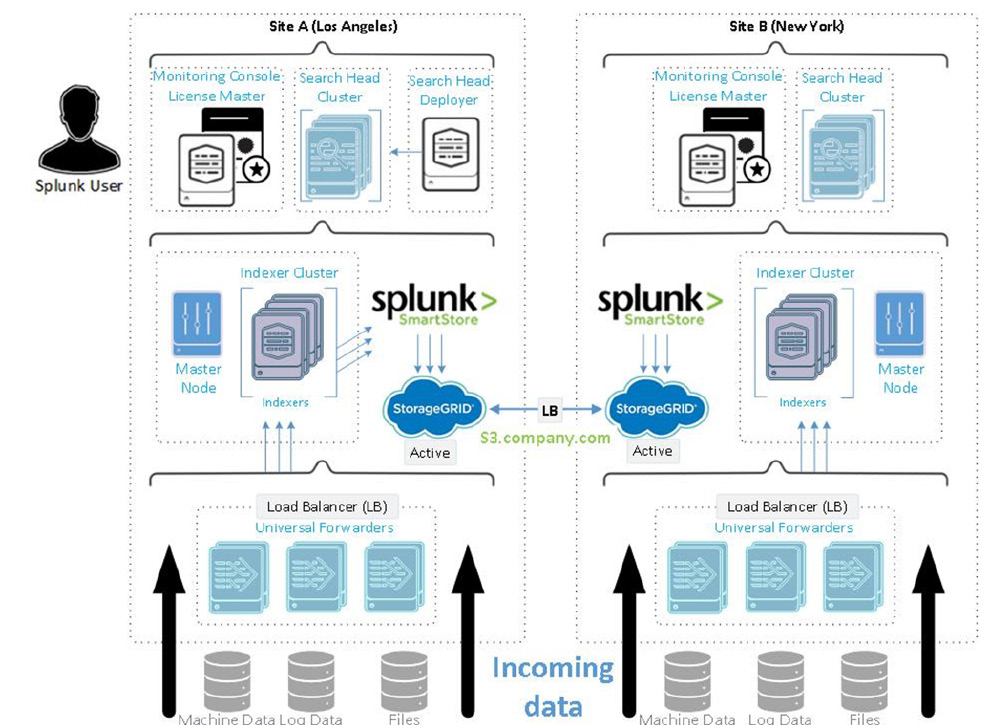
NetApp StorageGRID is a software-defined, object-based storage solution that supports industry-standard object APIs like the Amazon Simple Storage Service (Amazon S3) API. With StorageGRID, you can build a single namespace across up to 16 data centers worldwide, with customizable service levels for metadata-driven object lifecycle policies. The integrated lifecycle management policies optimize where your data lives throughout its lifecycle.

NetApp StorageGRID overview

Features and Benefits

The capabilities that set NetApp StorageGRID apart.

Key Benefits

OPTIMIZED

Accelerate AI workflows with StorageGRID, offering secure, resilient, and scalable storage for AI/ML data. Enjoy superior performance at 4-5x lower cost than public cloud, and benefit from industry-leading management, multi-tenancy, and QoS for object storage.

INTELLIGENT

Innovate faster with a native S3 solution in your unified data storage ecosystem. Achieve low-cost data management, performance, and governance, while leveraging AI-driven NetApp Classification for visibility and cost-efficient tiering.

MODERN

Drive next-gen apps with fluid data mobility and robust security. Seamlessly move data to any cloud without vendor lock-in or extra charges, relying on resilient, encrypted StorageGRID, available as an appliance or software-defined, for any scale.

Enable the hybrid cloud

User-controlled platform services

StorageGRID supports industry-leading hybrid cloud solutions with its user-controlled platform services. You can keep your data in a local private cloud while taking advantage of public cloud offerings. Storage tenants can configure mirroring of selected objects at the bucket level to an S3-compatible public cloud.

Hybrid cloud workflows

You can trigger hybrid cloud workflows by integrating S3 notification of events in your on-premises buckets with Amazon SNS. And you can gain further value with metadata search and analytics by streaming object metadata to an external Elasticsearch service, on premises or in the public cloud.

Amazon S3 APIs and industry-leading features

StorageGRID lets you take advantage of Amazon S3 APIs and industry-leading features such as object versioning, object locking, multipart upload, S3 Select, Amazon Identity and Access Management (IAM)-style access policies, cross-origin resource sharing, and object tags. With Active Directory and LDAP identity federation, StorageGRID bridges the gap between enterprise IT and cloud semantics.

Cloud-to-cloud data management

Cloud-to-cloud data management can also help you reduce costs. StorageGRID can manage and store objects in its own globally distributed infrastructure, and in Amazon S3 or S3-compatible object stores or public clouds. Depending on your hybrid cloud strategy, you can replicate data with the StorageGRID CloudMirror service to Amazon S3, Google Cloud, or an S3-compatible object store for data protection, or to leverage cloud services. And for further cost savings, you can tier cold StorageGRID data to the cloud through Cloud Storage Pool to Amazon S3, Google Cloud, or Microsoft Azure.

Facilitate compliance with tamper-proof data retention
Facilitate compliance with tamper-proof data retention

Multitenancy

StorageGRID is built with multitenancy at its core. Every tenant is its own partition, with its own rights and permissions, while sharing the same consolidated infrastructure. Not all tenants need to be the same; they can have different performance, capacity, and security requirements.

WORM retention with S3 Object Lock

Storage tenants can configure write once, read many (WORM) retention with StorageGRID S3 Object Lock (using governance or compliance mode) to comply with regulations. You can configure StorageGRID so that data is stored with multiple copies or logical equivalents, such as erasure-coded objects.

Security capabilities

You can secure your data with software-based encryption in flight and at rest, with built-in audit trails, and with FIPS drives on some StorageGRID appliances. And other features such as multifactor authentication, role-based access control, and external key management make StorageGRID a leader in security capabilities.

Use proven software designed for nondisruptive operations

11th-generation object store

StorageGRID is an 11th-generation object store with more than two decades of production deployments in the most demanding industries. With the strength of the portfolio, NetApp has demonstrated more than 20 years of product hardening with more than 1 million systems shipped.

NetApp Digital Advisor and world-class support

With advanced features such as the NetApp Digital Advisor for proactive, immediate response, and with backing by NetApp's world-class support organization, StorageGRID is a solution that you can trust with your critical data assets. StorageGRID also enables you to maintain and to update your infrastructure without business interruption or downtime.

Deploy granular data protection policies

Layered data protection

StorageGRID appliances provide layered data protection at the hardware and software levels. You can protect against failed disk drives and rapidly rebuild lost data segments with local, node-level erasure coding (EC) or redundant array of independent disks (RAID), and you can protect against site-level disasters with geo-distributed EC or in-grid replication.

Cross-grid replication (CGR)

For even greater protection, you can also replicate to another StorageGRID grid or to a cloud object store. An advanced grid federation functionality in StorageGRID enabled by cross-grid replication (CGR) feature provides tenant account cloning and an active-active object level disaster recovery solution.

Flexible deployments

Aligns with your environment

Because every deployment is unique, StorageGRID aligns with your environment, whether it includes nodes as VMs, as optimized hardware-based appliances, as bare-metal servers with Docker containers, or as a combination across virtual and physical environments. In all cases, designing, deploying, and managing StorageGRID is a centralized and streamlined process that enables you to rapidly deploy petabytes of storage.

StorageGRID service appliances

StorageGRID service appliances offer the option of even simpler deployment. The SG120 and SG1200 service appliances deliver an enterprise-grade load balancer with full high-availability (HA) capabilities as well as the option to host StorageGRID Admin Nodes. You can streamline deployments by implementing "all appliance grids." And you have the flexibility to operate the node or HA node pair as a load balancer, an admin node, or both roles simultaneously.

Enterprise-grade turnkey solution

By deploying NetApp StorageGRID appliances, you get an enterprise-grade turnkey solution that is easy to implement. Each appliance is built to meet specific performance or capacity needs. You can also deploy StorageGRID as a data-only or metadata-only Storage Node.

Software-only deployment

In addition, you can deploy software-only StorageGRID nodes as containers on physical or virtual servers, taking advantage of the heterogeneous storage underneath. If you're looking for greater agility and financial flexibility, StorageGRID is available through the NetApp Keystone storage-as-a-service offering.

Massive scalability and flexible infrastructure

NetApp StorageGRID provides

  • Massive elastic content store
  • Multiple geo-distributed sites
  • Support for multiple storage tiers:
    • NVMe, SSD, SAS, SATA, tape
    • Amazon S3
    • Microsoft Azure
    • Google Cloud
  • Geo-erasure coding and geo-replication
  • Deployment on VMs, hardware appliances, and bare-metal servers with Docker containers

Application interfaces

Massively parallel transaction engine

  • Integrated load balancing
  • Transaction multithread pipelining
  • Amazon S3 object access protocols

System and account management

  • Management API: System installation, system administration, tenant management, maintenance tasks, and system monitoring, including Prometheus
  • Tenant API: Management of users, credentials, usage, and quotas

Data services

Platform services—tenant-configurable hybrid cloud integration

  • S3 event notification with Amazon SNS and Kafka
  • CloudMirror bucket replication with Amazon S3, Google Cloud, or S3-compatible target
  • Metadata search and analysis with streaming metadata to external Elasticsearch WORM retention
  • S3 Object Lock (compliance and governance modes)
  • Reinforced data integrity with compliance-grade WORM storage
  • Litigation hold

Advanced security and encryption capabilities

  • Transport Security Layer (TSL) 1.3 and AES 256-bit encryption
  • Secure Hash Algorithm 2 (SHA-2) and CPU-efficient integrity protection
  • External key management
  • Automatic verification of StorageGRID upgrades and hot fixes with code signing functionality
  • FIPS-compliant encrypted connections for the load balancers to ensure data security, compliance, and confidentiality
  • Configurable firewall controls, management, and S3 endpoint ports

Disaster recovery

  • Cross-grid replication provides bucket-level active-active replication across grids

Metadata and content awareness

Metadata-based data management

  • Content-aware self-healing maintains data protection even during network disruptions
  • Policies can be modified and applied to both new and existing objects

Deployment options

Deployment options

  • Physical or virtual servers via Docker containers
  • Virtual appliance:
    • VMware ESXi and vCenter
  • Hardware appliances:
    • StorageGRID all-flash SGF6212 (TLC and QLC) for high-performance primary object storage workloads, web apps, streaming
    • StorageGRID SG6260 for transactional small object storage workloads
    • FabricPool optimization, with expansion shelf options for large-scale capacity, including data lakes
    • StorageGRID SG5812 and SG5860 for secondary, capacity object-storage workloads
    • StorageGRID SG120 and SG1200 service appliances for simplified operations, including Admin Node software and load balancing

Service-level objective and performance monitoring

Performance monitoring

  • Comprehensive performance feeds:
    • Access throughput
    • Replication throughput
    • Time to policies achieved
  • QoS rate limiting to manage workload performance
  • Transaction round-trip time
  • Isolated application, replication, and admin network traffic
  • Adjustable data policies with flexible information lifecycle management (ILM)
  • Advanced system monitoring with Prometheus

Management and monitoring

Management and monitoring

  • Centralized and automatable installation and expansions
  • Automated monitoring and tenant management through an API
  • Rolling upgrades without downtime
  • Comprehensive ad hoc real-time, rolling-period, and historical-usage query capability
  • More than 200 predefined monitoring, usage, and performance reports
  • Event-based audit messages for performance tracing, usage monitoring, and enabling billing or chargeback

Professional Services

Professional Services

  • Reduced deployment risk, streamlined implementation, and the ability to migrate quickly with minimal disruption
  • Discovery and design to determine solution requirements
  • Validated process for appliance deployment and software configuration
  • Data migration with proven methodologies and reliable tools
Expert Guidance

Thrive with expert-led storage guidance

Get tailored advice on how NetApp StorageGRID fits your environment — from sizing and deployment to long-term optimization.

Thrive with expert-led storage guidance

Technical Specifications

Exhaustive hardware and software metrics extracted directly from official documentation.

  • Drive types supported
    SED: 1.9TB, 3.8TB 15.3TB (TLC), FIPS: 3.8TB, 15.3TB (TLC) Non-SED: 30.7TB QLC SED: 61.4TB, 122.8TB (QLC)
  • Capacity
    22.8TB - 1475TB
  • Form factor
    1U, 12 drives
  • Connectivity
    4 x 10/25/40/200GbE
  • Width
    17.32" (44 cm)
  • Depth
    30.56" (77.62 cm)
  • Weight
    56.0 lb (25.39 kg)
  • Watts, Typical
    622

  • Drive types supported
    Non-FDE: 4TB, 10TB, 18TB, 24TB; FIPS: 10TB
  • Capacity
    No Exp Shelf: 240TB - 1320TB; 1 Exp Shelf: 480TB - 2640TB; 2 Exp Shelf: 720TB - 3960TB
  • Form factor
    No Exp Shelf: 5U, 60 drives; 1 Exp Shelf: 9U, 120 drives; 2 Exp Shelf: 13U, 180 drives
  • Connectivity
    4 x 10/25/40/200GbE
  • Width
    17.66" (44.86cm)
  • Depth
    38.25" (97.16cm)
  • Weight
    289 lb (131 kg)
  • Watts, Typical
    1579

  • Drive types supported
    Non-FDE: 4TB, 10TB, 18TB, 24TB; FIPS: 10TB
  • Capacity
    240TB - 1320TB
  • Form factor
    4U, 60 drives
  • Connectivity
    4 x 10/25GbE
  • Width
    17.66" (44.86cm)
  • Depth
    38.25" (97.16cm)
  • Weight
    250 lb (113 kg)
  • Watts, Typical
    1041

  • Drive types supported
    Non-FDE: 4TB, 10TB, 18TB, 24TB; FIPS: 10TB
  • Capacity
    48TB - 288TB
  • Form factor
    2U, 12 drives
  • Connectivity
    4 x 10/25GbE
  • Width
    17.6" (44.7cm)
  • Depth
    21.1" (53.6cm)
  • Weight
    63.9 lb (29 kg)
  • Watts, Typical
    403

  • Drive types supported
    Not applicable.
  • Capacity
    Not Applicable
  • Form factor
    1U
  • Connectivity
    4x 10/25/40/200GbE (SG1200); 4 x 10/25GbE (SG120)
  • Width
    17.32" (44 cm)
  • Depth
    30.56" (77.62 cm)
  • Weight
    43.4 lb (19.70 kg)
  • Watts, Typical
    557/432

Compare NetApp StorageGRID Series

Select the right scale for your workload demands.

Compare NetApp StorageGRID Series — capacity and port configuration by model.
Model Name Max Capacity Port Config Action
SGF6212 22.8TB - 1475TB 4 x 10/25/40/200GbE Get Quote
SG6260 240TB - 3960TB (with 2 Exp Shelves) 4 x 10/25/40/200GbE Get Quote
SG5860 240TB - 1320TB 4 x 10/25GbE Get Quote
SG5812 48TB - 288TB 4 x 10/25GbE Get Quote
SG1200 N/A 4 x 10/25/40/200GbE Get Quote
SG120 N/A 4 x 10/25GbE Get Quote

Ready to get started?

Get your data flowing from edge to core to cloud.

Talk to a specialist

Request a custom quote

Build a configuration with a Object Storage specialist.

Request a quote

Download the datasheet

Full specs, performance metrics, and deployment notes.

Get the datasheet

Learn more

Explore resources

Datasheets, whitepapers, case studies, and technical documentation.

Explore resources

View solutions

Tailored storage and data management solutions for your workloads.

View solutions
FREQUENTLY ASKED QUESTIONS

Common questions about NetApp StorageGRID

Answers to what enterprise IT leaders ask most before deploying NetApp StorageGRID with SANDataWorks.

StorageGRID is a software-defined, enterprise-grade object storage solution designed to handle petabytes to exabytes of unstructured data. It is primarily used for AI data preparation, massive media repositories, active archiving, and robust data backup and retention.

StorageGRID pairs natively with Dremio to create an open Agentic Data Lakehouse. Users run lightning-fast SQL queries directly on data stored in StorageGRID without migrating it to expensive proprietary data warehouses, drastically lowering TCO.

StorageGRID uses an intelligent Information Lifecycle Management (ILM) engine. Granular policies automatically tier older, cold data to the lowest-cost storage layer (on-premises or public cloud) or delete it when retention expires — saving up to 95% on storage costs.

Yes. StorageGRID offers compliance-grade Write Once, Read Many (WORM) retention and S3 Object Lock. Once data is written to the grid, it cannot be modified, encrypted, or deleted by ransomware or malicious insiders.

SANDataWorks deploys StorageGRID across geographically dispersed sites to create a single, highly durable namespace. Geo-erasure coding ensures your data is always available and protected against complete site failures with eleven nines (99.999999999%) of durability.

Most secure storage on the planet FIPS 140-3 · NSA CSfC · DoDIN APL
Validated for top-secret data Only enterprise storage to hold this certification
Authorized NetApp Partner SANDataWorks · a division of BlueAlly