Private Cloud
Build a dynamic private cloud with NetApp clustered Data ONTAP for greater IT flexibility, efficiency, and cost savings.

Meet your dynamic business needs by using the NetApp clustered Data ONTAP storage operating system. Data ONTAP is a universal data platform that lets you create a private cloud services delivery model and extend it to a hybrid cloud.
Use NetApp OnCommand management software’s automated and analytical tools to boost utilization and performance. Shift your blend of opex and capex as business needs require.
Technologies:
Enable IT as a service. Use NetApp clustered Data ONTAP to create a virtualized shared IT infrastructure.
Evolve your IT infrastructure to private cloud computing. Follow NetApp best practices:
- Service Analytics: Optimize your services.
- Automation: Deploy your services faster.
- Self-Service: Empower IT and your end users.
Key Point
- Reduce time to provision a system and activate new applications.
- Host multiple tenants on a single, secure shared infrastructure.
- Gain operational and staff efficiencies with standardized management.
- Reduce manual effort with policy-based automation.
Manage and maintain control over your private cloud environment. Leverage these NetApp core capabilities:
- NetApp clustered Data ONTAP software provides a single storage and data management platform that supports multiple workloads.
- Storage efficiency helps reduce capacity requirements and costs by 50% or more.
- Secure multi-tenancy segments, isolates, and delivers shared server, storage, and network resources.
- Service automation and analytics automate storage provisioning, comprehensive visibility, and monitoring.
- Integrated data protection helps meet your backup, disaster recovery, archiving, compliance, and security service-level agreements.
- Virtual storage tiering automates data movement based on application affinity and workload.
- Embedded data security protects data assets through role-based administration, encryption, and anti-virus.
NetApp technologies deliver quick, secure access for cloud services:
OpenStack software makes deployment of cloud services simpler, faster, and more scalable.
NetApp StorageGRID object storage software enables secure management of petabyte-scale distributed content repositories.
Innovative Solutions for the Private Cloud:
Build a dynamic private cloud. Evolve to hybrid cloud in a single platform built on clustered Data ONTAP with less risk.
Wherever your company is on its path to the cloud, NetApp and our partners can provide the solutions you need to meet your business goals.
Create an on-demand service delivery model built on the clustered Data ONTAP OS. Evolve it from a private cloud to a hybrid cloud in a single platform. Accelerate time to market. Automate faster. Reduce provisioning time and management costs. Achieve storage efficiency.
Choose from our broad ecosystem of cloud provider, application, and technology partner options.
Key Point
- Choose an integrated cloud solution that works for your business.
- Speed time to deployment by using prevalidated infrastructure solutions.
- Start with an on-premise private cloud, evolve to a hybrid cloud.
- Maintain data control and choice.
NetApp Cloud Solutions Portfolio:
- FlexPod Datacenter solutions
- NetApp for Microsoft Private Cloud
- NetApp Storage Solution for VMware Private Cloud
- Accenture Private Cloud Solution for SAP
- Fujitsu Dynamic Cloud Infrastructure
- Fujitsu vShape solutions
NetApp's service provider partner program offers a broad selection of cloud services built on NetApp.
Microsoft Cloud:
Accelerate, protect, and transform your business with cloud solutions from NetApp and Microsoft.
NetApp storage for virtualized servers and applications delivers intelligent management, automation, and self-service provisioning. Clustered Data ONTAP offers a universal data platform designed for the cloud, enabling nondisruptive operations, seamless scalability, and proven efficiency.
NetApp storage, in conjunction with Microsoft Cloud OS (PDF), scales from private to public cloud to accelerate deployment of cloud-based data center infrastructure, applications, and services. FlexPod Datacenter with Microsoft Private Cloud offers a proven, validated architecture to accelerate data center modernization.
With an infrastructure built on our proven enterprise storage, you can:
- Optimize virtualization investments. OnCommand Shift software provides fast, simple hypervisor conversion between VMware ESX/ESXi and Microsoft Hyper-V.
- Simplify management. Benefit from our deep integration with System Center and Windows Server 2012 R2. We offer OnCommand Plug-in for Microsoft, SnapManager for Hyper-V software, and a complete library of PowerShell cmdlets.
- Increase productivity. Streamline application data management, automate routine tasks, and free administrators to devote more time to high-value/ROI tasks.
- Move data between clouds. Extend IT infrastructure to Microsoft Azure to create a seamless hybrid cloud.
Key Point
- Deliver a private cloud with integrated management, virtualization, and automation.
- Transform your business with a powerful, secure hybrid cloud.
- Boost productivity from business-critical applications on the premises or in the cloud.
- Scale IT infrastructure and meet dynamic business needs.
- Go from zero to cloud-protected in less than 30 minutes
Transforming the Promise of the Cloud into Real Results
With the growing demands of modern business increasing the pressure on enterprise IT resources, many organizations are looking to the cloud for IT agility, efficiency, and scalability. That’s why cloud computing has become a business reality. The cloud model delivers on-demand and secure access to pools of IT resources, empowering companies to increase overall flexibility and efficiency while cutting capex and opex.
Today there’s one proven technology partnership that can provide it all, whether it’s on premises or next to or in the cloud: NetApp solutions for Microsoft cloud. Now your organization can protect your data, optimize performance, and increase productivity with storage that adapts dynamically to your capacity and efficiency needs, thanks to the clustered Data ONTAP operating system. NetApp’s deep integration with Microsoft cloud simplifies processes and transports data between cloud environments with a host of built-in efficiency and automation tools that make data management easy and cost-effective.
Unbound Cloud Vision
Unbound Cloud is NetApp’s overall cloud data management vision. NetApp’s universal data platform is designed for the cloud, enabling nondisruptive operations, seamless scalability, and proven efficiency. Within this vision, NetApp storage solutions deployed with Microsoft cloud accelerate the implementation of cloud-optimized data center infrastructure, IT services, and business applications.
NetApp Cloud Portfolio
NetApp’s comprehensive portfolio of storage solutions for Microsoft cloud includes:
- NetApp Solutions for Microsoft Private Cloud
- FlexPod Datacenter with Microsoft Private Cloud
- NetApp Private Storage for Microsoft Azure
Harnessing the Power of NetApp and Microsoft
IT agility and efficiency
Isn’t it time you simplified the management of your data with an efficient cloud-based solution? NetApp storage solutions featuring clustered Data ONTAP provide a single storage and data management platform that enables secure data movement across private, public, and hybrid clouds. When used in Microsoft cloud environments, NetApp storage accelerates deployment of cloudoptimized data center infrastructure, applications, and services:
- Deploy NetApp’s universal data platform to create an agile, fieldproven, and award-winning foundation for cloud-optimized storage, virtualization, and automation.
- Benefit from simplified data management capabilities that are deeply integrated with Microsoft System Center 2012 R2 and Windows Server 2012 R2.
- Reduce TCO with the FlexPod platform, an industry-leading converged infrastructure with Microsoft Private Cloud Fast Track validation and unified, best-in-class compute, networking, and storage.
Cloud scalability and enterprise storage
Together, NetApp and Microsoft provide high-performance, cloud-ready solutions that are as scalable as they are secure for enterprise applications, cloud bursting, development and test, and DR. For example, NetApp offers the first private storage solution for Microsoft Azure, providing the benefits of the cloud coupled with secure enterprise storage:
- Scale IT infrastructure and meet changing business needs with dynamic data portability.
- Boost IT efficiency with dynamic movement of data and workloads across cloud resources.
- Dynamically change the use of public and private cloud resources with software-defined storage that balances your opex-capex profile and optimizes your business infrastructure capability.
Cloud-optimized business efficiency
To meet the needs of your businesscritical applications, turn to a single platform that offers nondisruptive storage provisioning and operations, quality-of-service workload management, and space-efficient cloning on premises or next to or in the cloud. NetApp solutions for Microsoft cloud enhance performance and increase the agility of your businesscritical applications with reliability and optimal productivity:
- Meet challenging business needs with nondisruptive storage provisioning and operations, quality of service workload management, and space-efficient cloning on premises or next to or in the cloud.
- Reduce operational costs by leveraging centralized data management capabilities and cloud scalability to dynamically optimize data storage and accelerate compute capabilities.
- Increase productivity with streamlined data management and automated routine tasks, allowing administrators to spend less time performing maintenance and more time on high-value/ROI tasks.
NetApp Solutions for Microsoft Private Cloud
NetApp storage integration with Microsoft provides an ideal foundation for a Microsoft Private Cloud built on Windows Server 2012 R2 Hyper-V and System Center 2012 R2. Agile NetApp storage and data management capabilities enhance Microsoft Private Cloud deployments with powerful features such as:
- Storage efficiency
NetApp virtualizes the underlying storage environment to provide the same efficiencies and availability for storage that Hyper-V does for servers. Dynamically provision and resize storage, deduplicate redundant data, and create nearinstantaneous Snapshot backups. Leverage leading storage efficiency features such as thin provisioning, application-aware data protection, and multi-tenancy. - Unified platform
The NetApp unified data platform with clustered Data ONTAP provides a common and flexible foundation that supports multiple protocols (iSCSI, FC, FCoE SAN, and SMB/NAS) and diverse workloads, thereby meeting changing requirements without forklift upgrades. - Microsoft integration
Leverage integrated NetApp and Microsoft technologies to achieve cloud-based storage and server virtualization. Use Microsoft System Center 2012 R2 to manage your enterprise data center infrastructure, including enterprise applications such as Exchange Server, SQL Server, and SharePoint Server, as well as Citrix XenDesktop for virtual desktop infrastructure.
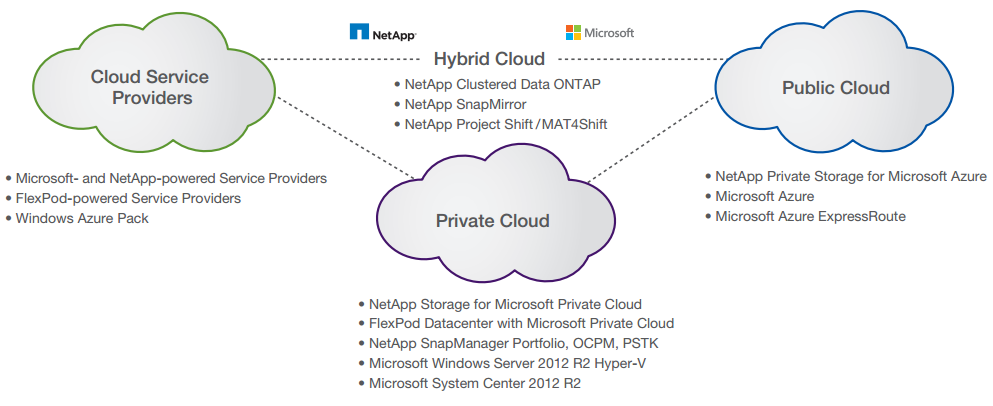
NetApp offers a comprehensive portfolio of storage solutions for Microsoft cloud environments.
FlexPod Datacenter for Microsoft Private Cloud
FlexPod Datacenter with Microsoft Private Cloud is a reference implementation validated by the Microsoft Private Cloud Fast Track program. The integrated solution combines NetApp and Cisco hardware and software with Microsoft software and consolidated guidance. Built on Windows Server 2012 R2 Hyper-V and Microsoft System Center 2012 R2, the solutions provide a streamlined approach to delivering scalable, preconfigured, and validated infrastructure platforms for on-premises private cloud implementations.
With local control over data and operations, IT can dynamically pool, allocate, secure, and manage resources for agile infrastructure as a service (IaaS). Likewise, business units can deploy line-of-business applications with speed and consistency using selfprovisioning (and decommissioning) and automated data center services in a virtualized environment.
The key hardware components of the converged infrastructure include NetApp FAS storage, Cisco Unified Computing System servers, and Cisco Nexus switches. The FlexPod Datacenter architecture can scale up or out and can be optimized for a variety of mixed workloads. FlexPod Datacenter provides an excellent Microsoft Private Cloud solution through:
- Award-winning systems management and operations.
FlexPod Datacenter with Microsoft Private Cloud won the 2013 Best of TechEd North America Award for Systems Management and Operations. - Validated solution.
Jointly validated technologies from industry leaders in computing, storage, networking, and server virtualization. - Integrated infrastructure.
One platform built from unified computing, fabric, and storage technologies with popular and trusted software virtualization. - Centralized management.
Integrated components let you centrally manage and automate all infrastructure pools, including unified SAN and NAS storage with support for SMB 3.0. - Open framework.
An open management framework integrates with your existing third-party infrastructure management solutions.
NetApp Private Storage for Microsoft Azure
Azure lets you build an agile, highperformance cloud infrastructure that balances private and cloud resources to optimize business outcomes. This flexible solution leverages the performance, agility, and control of private NetApp storage resources with the efficiency and elasticity benefits of Microsoft Azure. This enables your organization to simply and securely extend into the cloud without adding complexity. And it allows workloads to move seamlessly across cloud resources.
NetApp private storage connects to Microsoft Azure using Azure ExpressRoute, a private, highbandwidth, low-latency connection. So now you can connect directly to your private storage located at a colocation facility to Microsoft Azure. Equinix, a global interconnection and data center company, is the first colocation facility to offer direct, highspeed connections with ExpressRoute. NetApp testing has shown that ExpressRoute provides 36% better performance compared to VPN over public Internet connections.
NetApp Private Storage for Microsoft Azure benefits include:
- Enterprise workload optimization.
Combines the elasticity and savings of Microsoft Azure with the speed, reliability, and availability of NetApp storage for enterprise workloads such as Microsoft SQL Server, Oracle, SAP, and more. - Peak workload management.
Match compute resources to utilization and avoid large capex investments that would otherwise be required for peak, unforecasted, or seasonal workloads. - Disaster recovery at a lower cost.
Cost-effective single- or multiregion disaster recovery can be deployed by activating Azure only in DR test and failover scenarios. - Store data “next to” instead of “in” the cloud.
By locating your data next to Azure within an ExpressRoute-enabled colocation, you retain control of your data while enabling performance similar to that of on-premises infrastructure stacks. - Compliance and sovereignty regulations.
NetApp private storage helps you meet compliance requirements, because you own your storage and know where your data lives at all times. Advanced NetApp compliance features include SnapLock and NetApp disk encryption. - Optimize cloud resources.
The use of Microsoft System Center 2012 R2 and Data ONTAP PowerShell Toolkit enables optimized management and mobility of data between private cloud and private storage connected to Azure.
Addressing Business Challenges with Hybrid Clouds
As part of its Unbound Cloud vision, NetApp is building on its proven portfolio of cloud solutions so that organizations can take Microsoft cloud to the next level. NetApp’s unique combination of capabilities and partnerships allows enterprise organizations to embrace the hybrid cloud with seamless data management and full control of data across private, public, and hybrid cloud resources.
NetApp makes it easy to efficiently connect with on-premises and other clouds enabled by Data ONTAP using the same NetApp data movement and portability technologies that move data between remote physical NetApp storage devices. This means that organizations can respond instantly to ever-changing demands by dynamically moving data and applications among cloud resources and providers. By leveraging storage replication software, NetApp SnapMirror technology, and other innovative NetApp technologies for on-the-fly translation between cloud environments, organizations will be able to quickly and efficiently move data to optimize cloud resources. Facilitating data movement across clouds with stewardship is a core NetApp strength and increasingly critical as companies seek to leverage a hybrid data center to lower costs and increase agility. Our goal is to support IT organizations with a reliable cloud data fabric across all types of clouds as they evolve from builders of applications and operators of data centers to brokers of information services.
Our Commitment to You
NetApp and Microsoft have been working together for over a decade to provide innovative solutions that make it easier for our customers to rapidly transform their data centers for the future. We have worked closely to optimize NetApp storage and data management solutions for Microsoft environments and applications. NetApp’s award-winning solutions for Private Cloud, including FlexPod Datacenter, have helped customers accelerate the deployment of Microsoft Cloud OS technologies such as Windows Server with Hyper-V and System Center. Today, more than 30,000 global enterprise customers store, protect, and manage their Microsoft application data with NetApp. Recently, NetApp was recognized as a “best-in-class” Microsoft partner, with two finalist spots at the Microsoft 2014 Partner of the Year Awards. When you deploy Microsoft cloud solutions on NetApp storage, you know that you’re getting a highly efficient, flexible, and reliable solution that will help your budget go further and your business go faster.
VMware Private Cloud:
Evolve your virtualized VMware and NetApp storage environment to the cloud, improving IT efficiency and time to market.
NetApp and VMware accelerate your path to the cloud. Use the NetApp Storage Solution for VMware Private Cloud to deliver and procure cloud services for increased efficiency, greater business flexibility, and faster time to market.
With tight integration of core cloud computing technologies, the joint solution lets enterprises:
- Deploy VMware vCloud Suite on a data storage foundation designed to reduce cost and complexity.
- Isolate multiple tenants on a secure shared IT infrastructure.
- Perform instant, space-efficient, point-in-time backups and restores with NetApp Snapshot copies.
- Provision virtual data centers (vDCs) and underlying VMware vSphere resources from a single console.
- Expand storage resources for vDCs and vApps from within the VMware vCenter software.
- Provision vCloud resources to meet stringent SLAs.
- Leverage NetApp Virtual Storage Console to streamline deployment and management.
- Provide integrated enterprise-class data protection with NetApp Snap Creator software.
- Keep services always available with the NetApp clustered Data ONTAP OS.
Key Point
- Evolve from virtualization to a dynamic, automated cloud environment.
- Realize faster time to market through on-demand, orchestrated provisioning.
- Perform space-efficient cloud backups and restores in minutes.
- Manage storage operations with VMware vCenter Orchestrator integration.
- Gain nondisruptive operations for vCloud environments.
Making the Transition to the Cloud
Virtualization goes a long way toward improving resource utilization, reducing power and cooling consumption, and increasing asset-to-administrator ratios. Cloud environments build upon virtualized infrastructures and expand their capabilities to offer a service-driven IT model that improves IT agility and responsiveness to business needs.
The transformation to cloud computing requires that you expand your focus beyond the infrastructure optimization provided by virtualization and include operational efficiencies and IT service optimization. Cloud environments address these requirements with intelligent, automated provisioning; end-to-end visibility; and centralized management of cloud assets. Additional cloud attributes include integrated data protection and real-time data mobility to deliver nondisruptive operations and dynamic service-level management.
The Solution
NetApp and VMware—leaders in storage and data management and virtualization solutions, respectively—share a common vision to accelerate the path to the cloud through advanced virtualization, automation, and self-service capabilities. The NetApp solution for VMware Private Cloud, available as a NetApp Verified Architecture, combines innovative NetApp and VMware technologies and best practices, enabling enterprises and service providers to rapidly deploy an integrated cloud solution built on a shared virtualized infrastructure. Together our industry-leading storage, virtualization, and cloud technologies provide an agile data infrastructure that enables enterprises to evolve to the cloud and deliver IT as a service for increased business agility with lower cost and complexity.
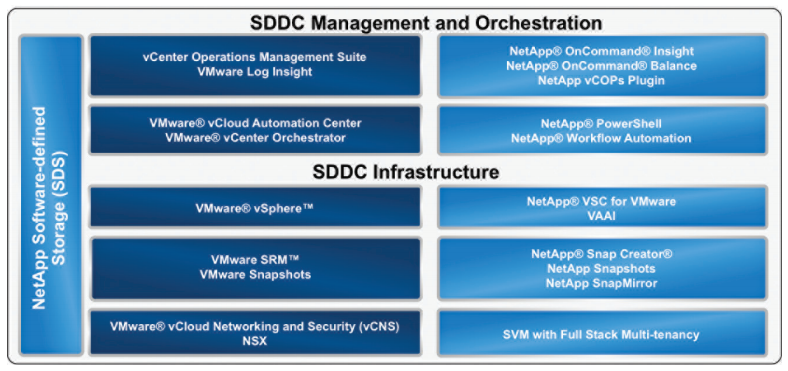
Overview of the NetApp storage solution for VMware Private Cloud.
The Right Storage Infrastructure is Paramount
The storage platform is a key element of the infrastructure layer. Storage efficiency, a unified architecture, HA, multiprotocol capability, ease of management, integration with VMware vCloud® Suite, and enterprise backup and DR capability are all earmarks of cloud-enabled storage. The NetApp Unified Storage Architecture extends all of the efficiencies and flexibility already available for VMware vSphere® virtualized environments to VMware vCloud Suite, enabling companies to more efficiently realize the full benefits of cloud computing.
More Efficient IT
The NetApp solution for VMware Private Cloud features the NetApp Unified Storage Architecture and the Data ONTAP architecture, the world’s number-one storage operating system. Both technologies span all NetApp storage systems for simplified management and smooth, nearly unlimited scalability. Our single, unified storage platform supports multiple protocols (FC, FCoE, iSCSI, NFS, CIFS) and diverse workloads to meet changing requirements without requiring forklift upgrades. Multiprotocol access to a single pool of storage brings simplicity and flexibility to your VMware vCloud Suite services. NetApp storage efficiencies also include built-in deduplication, thin provisioning, space-efficient Snapshot backups, and zero-cost virtual machine cloning. Together they can reduce storage requirements by 50% or more in VMware environments.
The solution also offers NetApp technology integration at multiple layers of the VMware vCloud Suite, enhancing operational efficiencies with automated monitoring, backup, disaster recovery, provisioning, and more.
Faster Response to the Business
The integration of NetApp Virtual Storage Console (VSC) with the VMware vCenter server management platform enables VMware administrators to manage and execute shared storage activities from a single console. You can provision storage and server resources and clone VMs within minutes for rapid response to business needs. NetApp storage resources can also be automatically expanded from within a VMware vCenter server based on intelligent policies to accommodate new vApps or grow existing ones. VSC also enables integrated data protection capabilities for simplified backup and recovery.
NetApp OnCommand Insight and Balance products complement the VMware vCenter Operations (vCO) Management Suite. Together they provide end-to-end monitoring, cost reporting, and visibility into service paths and resource usage for virtual machines, physical hosts, and storage, including datastores, volumes, and LUNs. These important service analytics help you avoid bottlenecks, optimize performance, and plan capacity for smart resource procurement and proactive service-level management.
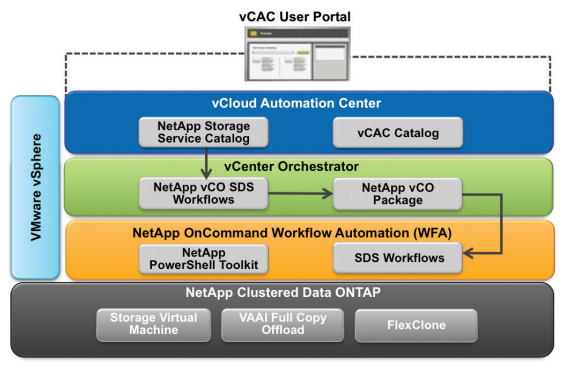
Software-defined storage with NetApp and VMware.
Streamlined Management and Orchestration
NetApp open APIs and Windows PowerShell extensibility enable our technologies to be easily integrated with VMware at a higher abstraction layer. For example, custom workflows for automated storage and virtual machine provisioning, cloning, and data protection can be driven by your cloud management software without exposing the complexity of the underlying operations.
WFA extends the value of NetApp storage through integration with vCloud Automation Center (vCAC) to create a storage services catalog that presents modular workflows as catalog items that can be used to initiate advanced storage capabilities such as provision, migrate, and decommission storage with single-click automation using vCAC. You can also make these capabilities directly available to users of IT resources, thus enabling users to request and gain access to storage on an as-needed basis, with intervention by the storage administrator. The provisioning process is automated, saving considerable time and improving productivity.
In addition to using WFA’s extensive library of built-in storage automation workflows, you can also rapidly create custom workflows in WFA through its WISIWIG editor to automate any service that exposes an API or PowerShell interface. WFA also exposes a web services interface for vCO to leverage. Working together, WFA and vCO can create a workflow to provide you with a fast, repeatable, and scalable process to clone vApps inside vCloud Automation Center, seamlessly extending NetApp capabilities into VMware private clouds.
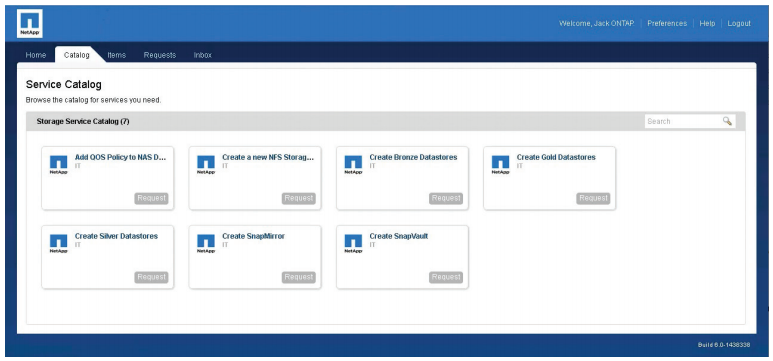
Using VMware vCAC and the NetApp Storage Service Catalog to manage SDS.
Nondisruptive Operations
The NetApp clustered Data ONTAP operating system provides the scalability, flexibility, and efficiency needed for storage that VMware provides for servers. It supports a scale-out storage architecture based on virtual storage systems (Vservers) that can be expanded and moved on demand to deliver dynamic quality of service (QoS). Now you can eliminate planned downtime for maintenance, technology refreshes, software upgrades, and load balancing by moving data volumes to other storage nodes in the cluster without disrupting applications or users. Clustered Data ONTAP also addresses fast data growth with massive scalability, supporting up to 24 nodes and more than 50PB of storage with consistent management and near-linear performance.
Simplified, Integrated Data Protection
The NetApp solution for VMware Private Cloud includes integrated data protection capabilities for simplified backup and recovery. The NetApp Snap Creator framework enables instant, space-efficient, point-in-time backup copies to be scheduled, automatically created, and managed from a single interface. Snap Creator also supports application-consistent backups for multiple applications and databases on multiple operating systems and virtual environments, all managed with a single solution from a single interface.
For fast, integrated disaster recovery, NetApp developed the Storage Replication Adapter, which coordinates DR operations among NetApp SnapMirror, NetApp FlexClone, and VMware Site Recovery Manager technologies. In the event of site outages, you can recover entire virtual infrastructures, including VMs, applications, and data, in minutes.
Optimizing Security and Quality of Service for Multiple Tenants
The NetApp solution for VMware Private Cloud enables secure multi-tenancy (SMT) in shared IT infrastructures. It includes the capability to partition shared virtualized storage and server resources and securely isolate the partitions to meet the needs of individual tenants (applications, departments, business units, virtual data centers, or customers).
NetApp MultiStore software, a key SMT component, complements VMware vCloud Networking and Security (vCNS) by enabling data for multiple tenants to reside on a single NetApp array. It simultaneously provides the ability to establish secure partitions and unique service levels for each tenant. Because each partition is treated as a separate virtual storage system, multi-tenancy can be used to improve both storage utilization and QoS management for each tenant residing on the array. Storage resources assigned to each tenant can also be dynamically resized to meet changing business demands without compromising security or SLAs. By extending security, flexibility, and service efficiencies across the server and storage infrastructure, secure multi-tenancy facilitates a dynamic shared cloud environment.
Agile Data Infrastructure
NetApp storage enables backup and recovery, storage analytics, storage orchestration, storage services management, and storage policy management from within vCenter. This tight-knit integration further increases manageability and control within the environment to reduce complexity, time, and effort. This enables you to more easily deploy an agile and scalable shared storage infrastructure for your VMware Private Cloud.
Minimizing Risk and Accelerating Results
The NetApp solution for VMware Private Cloud is a NetApp Verified Architecture (NVA), a thoroughly tested and integrated architecture that provides a seal of assurance for NetApp solutions. The NVA designation is intended to provide customers and partners with the highest level of confidence in deploying NetApp solutions. An NVA solution is backed by prescriptive deployment, testing, and operational procedures that minimize deployment risk and accelerate time to results.
Partnering for Your Success
The NetApp solution for VMware Private Cloud combines the best of storage, virtualization, and cloud technologies to help you boost IT efficiency and agility while reducing cost and complexity. It enables you to imple ment the core capabilities required for cloud computing, including automated on-demand provisioning, integrated data protection, and centralized cloud management. You can meet both SLA and security needs with secure multi-tenancy and provide always-on operations with clustered Data ONTAP for nondisruptive scalability and data mobility across clouds.